
Seller INFORMATION Book a Private Consultation Let’s map a plan that to showcases your property to the right buyer in the market. Michael Donoghue 0411 223 222
01 Form 2 Seller Disclosure 02 ATO Clearance Certificate 03 Campaign Agent — Marketing Finance 04 Smoke Alarm Legislation 05 Land Tax in Queensland 06 GST & Property Sales 07 Property Advertising Rules 08 Pool Safety & Compliance 09 AML/CTF Rules for Property Sales 10 Benefits of Selling at Auction 11 Preparing for Auction Day 12 Open Homes before Auction Day 13 The Reserve Price 14 Your Role on Auction Day 15 Frequently Asked Questions Contents
01 - SELLER OBLIGATIONS Form 2 Seller Disclosure Under Queensland's new disclosure scheme, Sellers must provide a completed Seller Disclosure Statement before any Buyer signs a Contract of Sale. Here's what you need to know. Who Does It Apply To? Contracts for sale of freehold land signed on or after 1 August 2025 Covers residential and commercial sales private treaty, tender, auction, and mortgagee sales Cannot be contracted out of (limited exemptions apply) What Must the Seller Provide? Completed Seller Disclosure Statement (approved form) All applicable prescribed certificates All documents must be provided before the Buyer signs the Contract of Sale What Does It Cover? Seller and property details Title search and survey plan Unregistered encumbrances (leases, easements, statutory rights) Zoning, transport proposals, contamination, environmental notices Pools, owner-builder work, enforcement notices Rates and water charges Body corporate documents (if applicable) Flood or natural hazard history Structural condition or pest issues Service connections Past building approvals Buyer Termination Rights The Buyer may terminate if there is a material inaccuracy or omission affecting the property The Buyer may terminate any time up to settlement date if a Form 2 was not provided before signing a contract Important note: Special disclosure rules apply to auctions. Both Sellers and Buyers should obtain independent legal advice. The information we provide is of a general nature only and should not be relied upon as legal, financial, taxation, technical, building, compliance, or other professional advice. We recommend obtaining independent advice from a suitably qualified professional relevant to your circumstances.
02 - TAXATION ATO Clearance Certificate Australian Residents Foreign Residents All Australian residents for tax purposes must have a valid clearance certificate issued by the ATO at or before settlement. Without it, the purchaser must withhold 15% from the sale proceeds and pay it to the ATO. Foreign residents may incur Capital Gains Tax (CGT) on the sale of Australian property. Purchasers withhold FRCGW from the sale price unless the foreign resident vendor holds a variation notice specifying a reduced rate. Key things to know when selling Apply for a Clearance Certificate as soon as you're thinking of selling (they are free) Each Seller must give their certificate to the purchaser at or before the settlement date Most certificates issue within a few days, but some can take up to 28 days Clearance Certificates are valid for 12 months from the date of issue (provided residency status doesn't change) The Seller would need to wait until their next year's tax return to recover the withheld amount If you decide not to sell but already hold a Clearance Certificate, there is no requirement to use it The information we provide is of a general nature only and should not be relied upon as legal, financial, taxation, technical, building, compliance, or other professional advice. We recommend obtaining independent advice from a suitably qualified professional relevant to your circumstances.
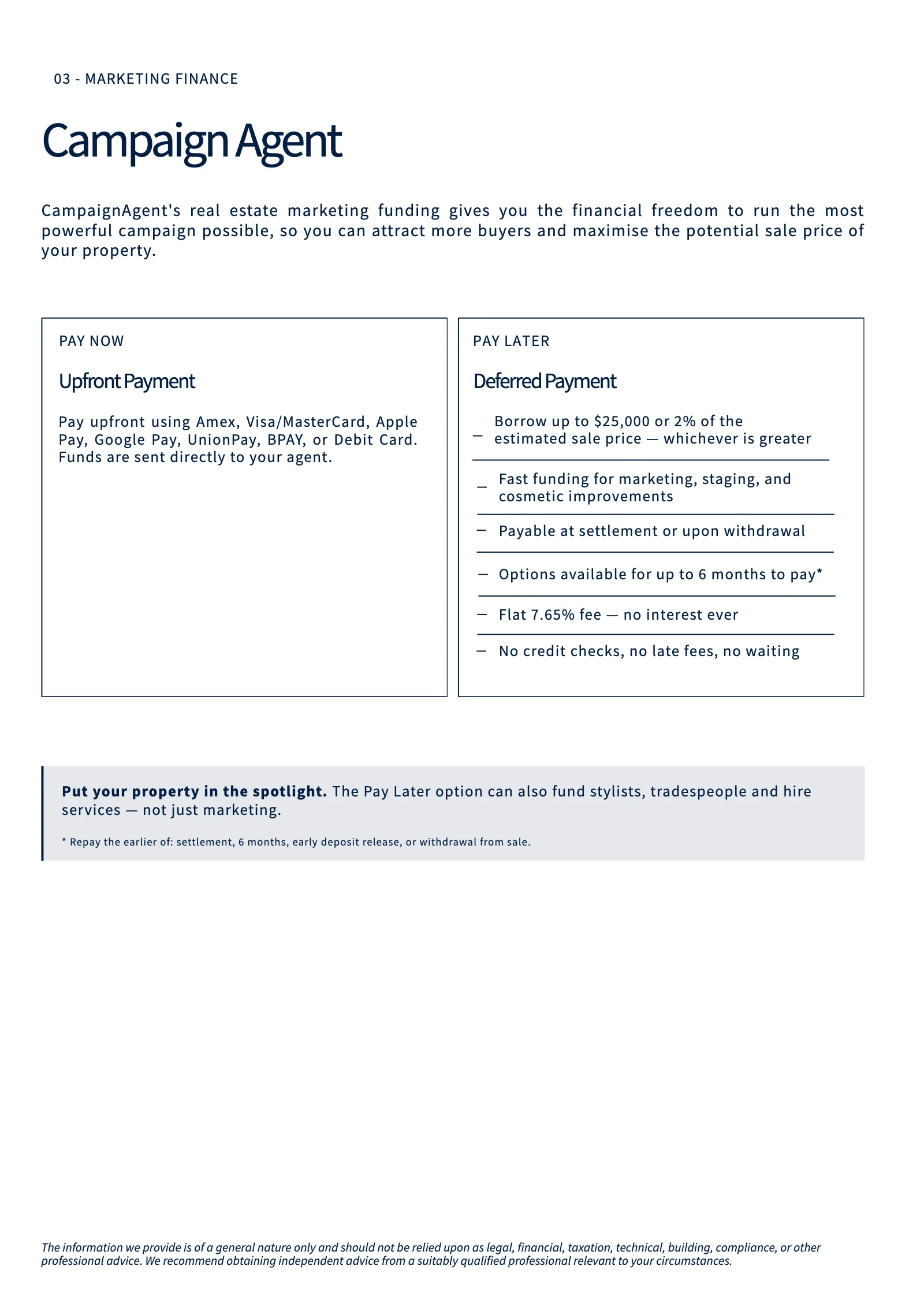
03 - MARKETING FINANCE Campaign Agent CampaignAgent's real estate marketing funding gives you the financial freedom to run the most powerful campaign possible, so you can attract more buyers and maximise the potential sale price of your property. PAY NOW Upfront Payment Pay upfront using Amex, Visa/MasterCard, Apple Pay, Google Pay, UnionPay, BPAY, or Debit Card. Funds are sent directly to your agent. PAY LATER Deferred Payment Borrow up to $25,000 or 2% of the estimated sale price — whichever is greater Fast funding for marketing, staging, and cosmetic improvements Payable at settlement or upon withdrawal Flat 7.65% fee — no interest ever No credit checks, no late fees, no waiting Put your property in the spotlight. The Pay Later option can also fund stylists, tradespeople and hire services — not just marketing. * Repay the earlier of: settlement, 6 months, early deposit release, or withdrawal from sale. Options available for up to 6 months to pay* The information we provide is of a general nature only and should not be relied upon as legal, financial, taxation, technical, building, compliance, or other professional advice. We recommend obtaining independent advice from a suitably qualified professional relevant to your circumstances.
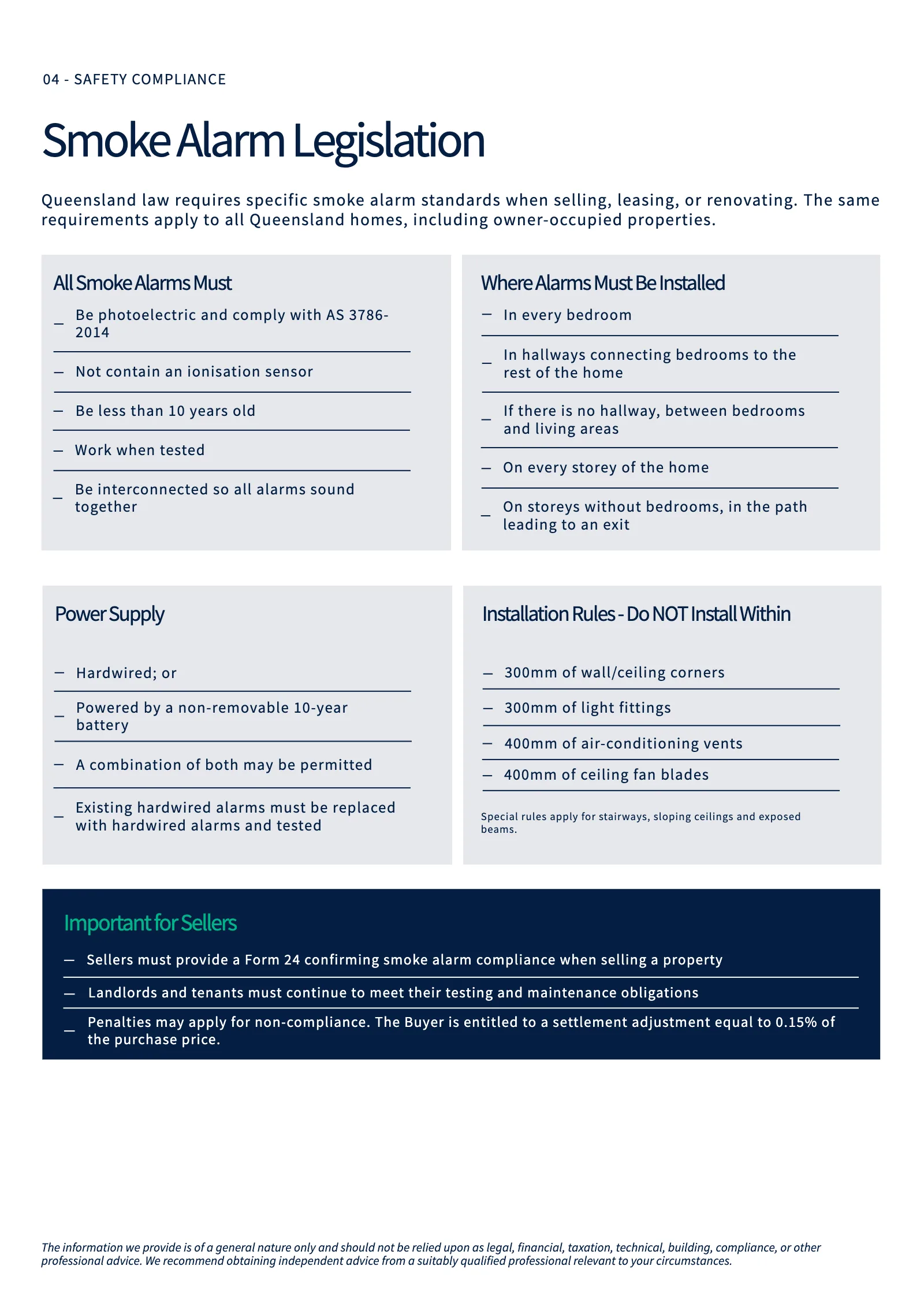
04 - SAFETY COMPLIANCE Smoke Alarm Legislation Queensland law requires specific smoke alarm standards when selling, leasing, or renovating. The same requirements apply to all Queensland homes, including owner-occupied properties. All Smoke Alarms Must Where Alarms Must Be Installed Power Supply Installation Rules - Do NOT Install Within Important for Sellers Landlords and tenants must continue to meet their testing and maintenance obligations Sellers must provide a Form 24 confirming smoke alarm compliance when selling a property Penalties may apply for non-compliance. The Buyer is entitled to a settlement adjustment equal to 0.15% of the purchase price. Be photoelectric and comply with AS 3786- 2014 Not contain an ionisation sensor Be less than 10 years old Work when tested Be interconnected so all alarms sound together In every bedroom In hallways connecting bedrooms to the rest of the home If there is no hallway, between bedrooms and living areas On every storey of the home On storeys without bedrooms, in the path leading to an exit Hardwired; or Powered by a non-removable 10-year battery A combination of both may be permitted Existing hardwired alarms must be replaced with hardwired alarms and tested 300mm of wall/ceiling corners 300mm of light fittings 400mm of air-conditioning vents 400mm of ceiling fan blades Special rules apply for stairways, sloping ceilings and exposed beams. The information we provide is of a general nature only and should not be relied upon as legal, financial, taxation, technical, building, compliance, or other professional advice. We recommend obtaining independent advice from a suitably qualified professional relevant to your circumstances.
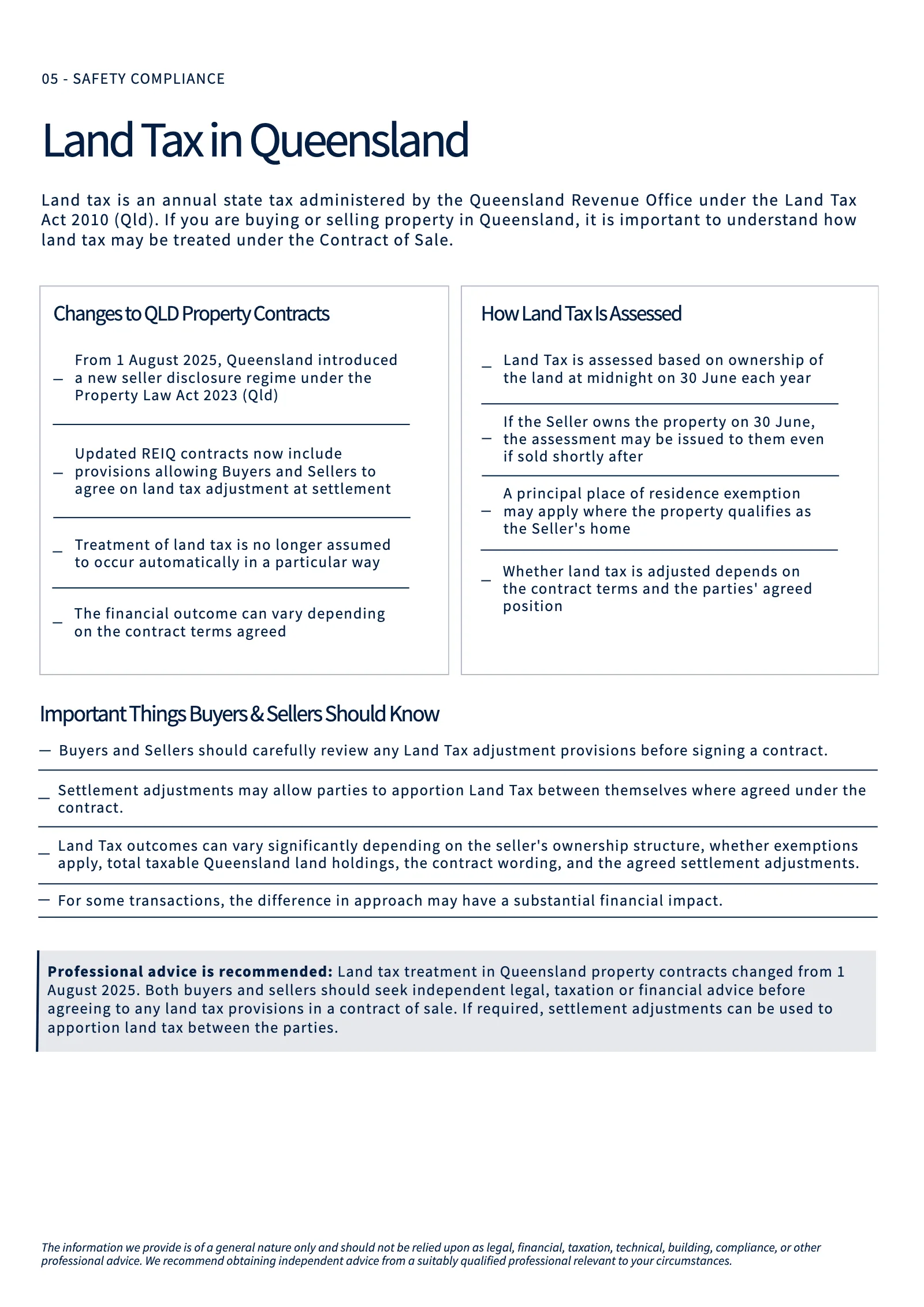
05 - SAFETY COMPLIANCE Land Tax in Queensland Land tax is an annual state tax administered by the Queensland Revenue Office under the Land Tax Act 2010 (Qld). If you are buying or selling property in Queensland, it is important to understand how land tax may be treated under the Contract of Sale. Changes to QLD Property Contracts How Land Tax Is Assessed From 1 August 2025, Queensland introduced a new seller disclosure regime under the Property Law Act 2023 (Qld) Updated REIQ contracts now include provisions allowing Buyers and Sellers to agree on land tax adjustment at settlement Treatment of land tax is no longer assumed to occur automatically in a particular way The financial outcome can vary depending on the contract terms agreed Land Tax is assessed based on ownership of the land at midnight on 30 June each year If the Seller owns the property on 30 June, the assessment may be issued to them even if sold shortly after A principal place of residence exemption may apply where the property qualifies as the Seller's home Whether land tax is adjusted depends on the contract terms and the parties' agreed position Professional advice is recommended: Land tax treatment in Queensland property contracts changed from 1 August 2025. Both buyers and sellers should seek independent legal, taxation or financial advice before agreeing to any land tax provisions in a contract of sale. If required, settlement adjustments can be used to apportion land tax between the parties. Important Things Buyers & Sellers Should Know Buyers and Sellers should carefully review any Land Tax adjustment provisions before signing a contract. Settlement adjustments may allow parties to apportion Land Tax between themselves where agreed under the contract. Land Tax outcomes can vary significantly depending on the seller's ownership structure, whether exemptions apply, total taxable Queensland land holdings, the contract wording, and the agreed settlement adjustments. For some transactions, the difference in approach may have a substantial financial impact. The information we provide is of a general nature only and should not be relied upon as legal, financial, taxation, technical, building, compliance, or other professional advice. We recommend obtaining independent advice from a suitably qualified professional relevant to your circumstances.
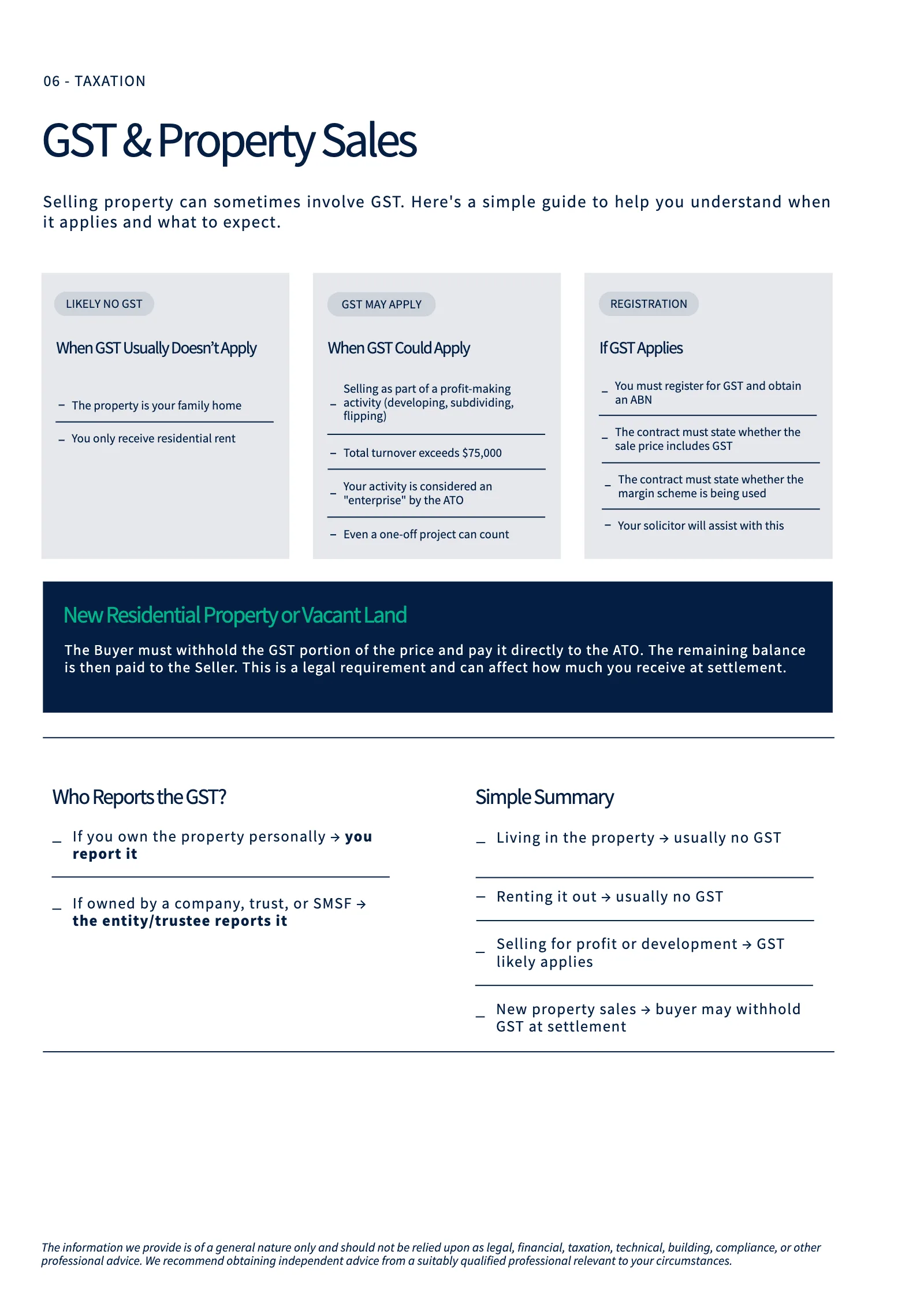
06 - TAXATION GST & Property Sales Selling property can sometimes involve GST. Here's a simple guide to help you understand when it applies and what to expect. LIKELY NO GST When GST Usually Doesn’t Apply The property is your family home You only receive residential rent GST MAY APPLY When GST Could Apply Selling as part of a profit-making activity (developing, subdividing, flipping) Total turnover exceeds $75,000 If GST Applies You must register for GST and obtain an ABN The contract must state whether the sale price includes GST Your activity is considered an "enterprise" by the ATO Even a one-off project can count REGISTRATION The contract must state whether the margin scheme is being used Your solicitor will assist with this New Residential Property or Vacant Land The Buyer must withhold the GST portion of the price and pay it directly to the ATO. The remaining balance is then paid to the Seller. This is a legal requirement and can affect how much you receive at settlement. Who Reports the GST? Simple Summary If you own the property personally → you report it If owned by a company, trust, or SMSF → the entity/trustee reports it Living in the property → usually no GST Renting it out → usually no GST Selling for profit or development → GST likely applies New property sales → buyer may withhold GST at settlement The information we provide is of a general nature only and should not be relied upon as legal, financial, taxation, technical, building, compliance, or other professional advice. We recommend obtaining independent advice from a suitably qualified professional relevant to your circumstances.
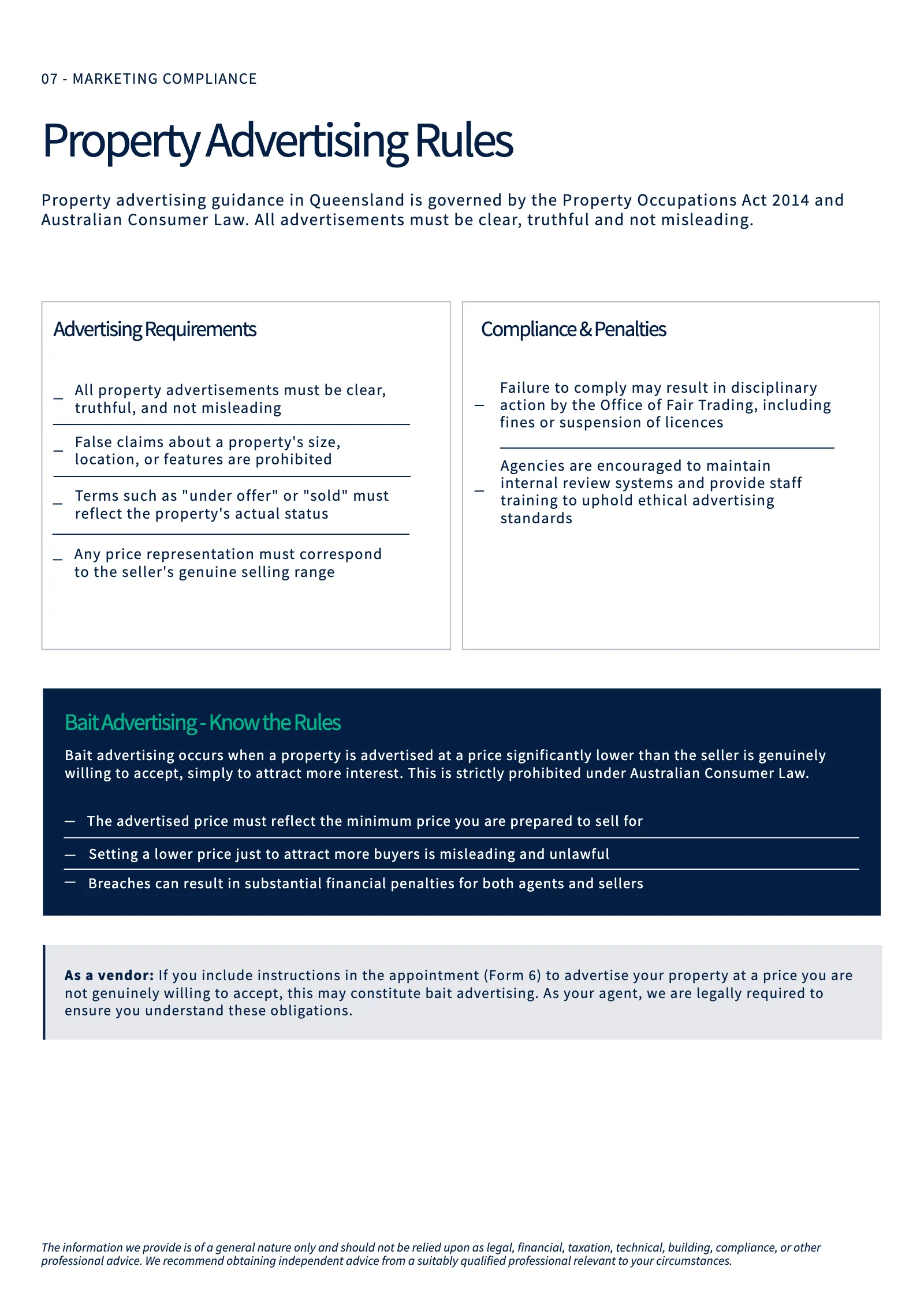
07 - MARKETING COMPLIANCE Property Advertising Rules Property advertising guidance in Queensland is governed by the Property Occupations Act 2014 and Australian Consumer Law. All advertisements must be clear, truthful and not misleading. Advertising Requirements Compliance & Penalties All property advertisements must be clear, truthful, and not misleading False claims about a property's size, location, or features are prohibited Terms such as "under offer" or "sold" must reflect the property's actual status Any price representation must correspond to the seller's genuine selling range Failure to comply may result in disciplinary action by the Office of Fair Trading, including fines or suspension of licences Bait Advertising - Know the Rules Setting a lower price just to attract more buyers is misleading and unlawful The advertised price must reflect the minimum price you are prepared to sell for Breaches can result in substantial financial penalties for both agents and sellers Bait advertising occurs when a property is advertised at a price significantly lower than the seller is genuinely willing to accept, simply to attract more interest. This is strictly prohibited under Australian Consumer Law. As a vendor: If you include instructions in the appointment (Form 6) to advertise your property at a price you are not genuinely willing to accept, this may constitute bait advertising. As your agent, we are legally required to ensure you understand these obligations. Agencies are encouraged to maintain internal review systems and provide staff training to uphold ethical advertising standards The information we provide is of a general nature only and should not be relied upon as legal, financial, taxation, technical, building, compliance, or other professional advice. We recommend obtaining independent advice from a suitably qualified professional relevant to your circumstances.
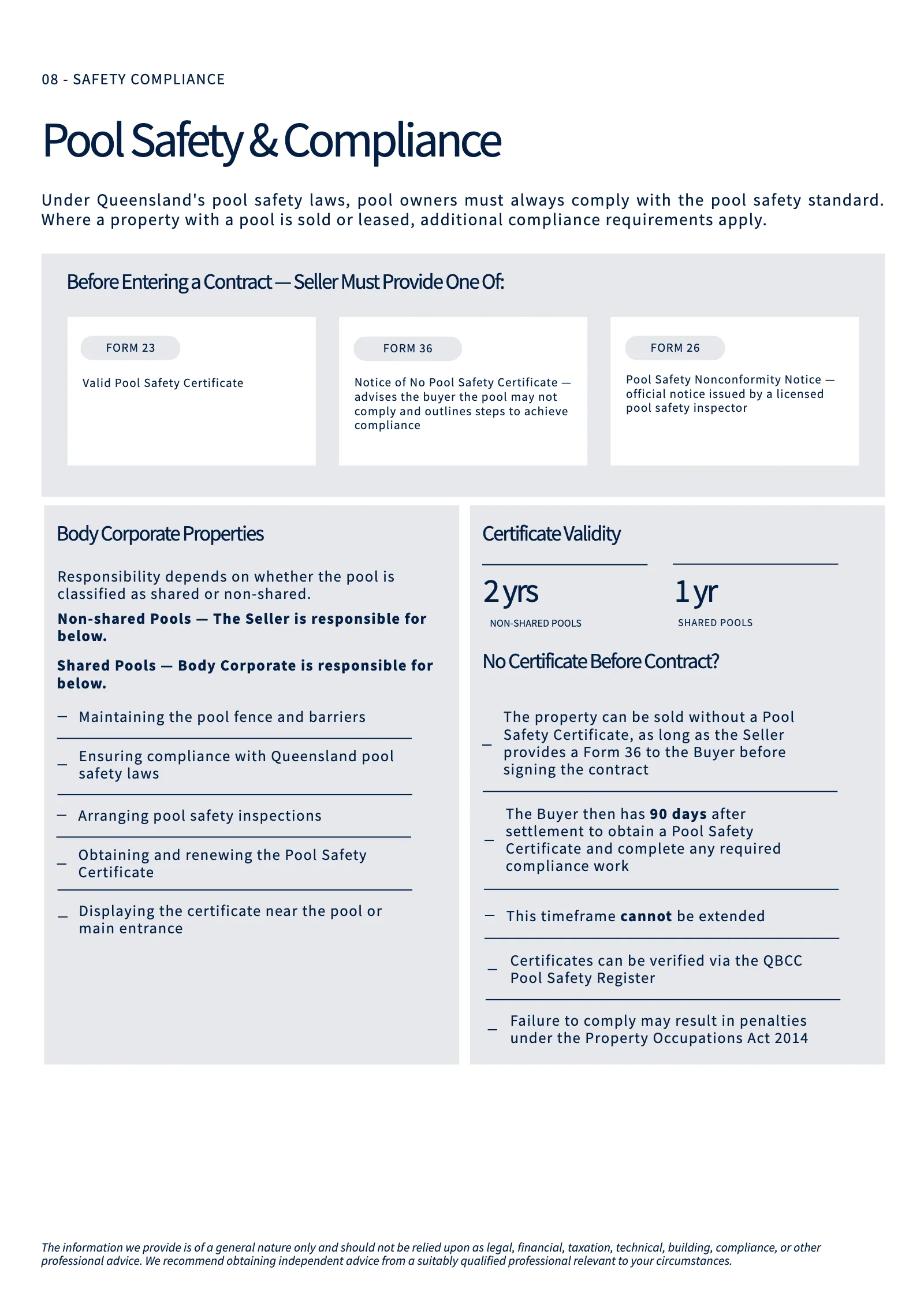
08 - SAFETY COMPLIANCE Pool Safety & Compliance Under Queensland's pool safety laws, pool owners must always comply with the pool safety standard. Where a property with a pool is sold or leased, additional compliance requirements apply. Before Entering a Contract — Seller Must Provide One Of: FORM 23 Valid Pool Safety Certificate FORM 36 Notice of No Pool Safety Certificate — advises the buyer the pool may not comply and outlines steps to achieve compliance Pool Safety Nonconformity Notice — official notice issued by a licensed pool safety inspector FORM 26 Body Corporate Properties Maintaining the pool fence and barriers Ensuring compliance with Queensland pool safety laws Arranging pool safety inspections Obtaining and renewing the Pool Safety Certificate Responsibility depends on whether the pool is classified as shared or non-shared. Displaying the certificate near the pool or main entrance Certificate Validity 2 yrs 1 yr NON-SHARED POOLS SHARED POOLS No Certificate Before Contract? This timeframe cannot be extended Certificates can be verified via the QBCC Pool Safety Register Failure to comply may result in penalties under the Property Occupations Act 2014 The property can be sold without a Pool Safety Certificate, as long as the Seller provides a Form 36 to the Buyer before signing the contract The Buyer then has 90 days after settlement to obtain a Pool Safety Certificate and complete any required compliance work Shared Pools — Body Corporate is responsible for below. Non-shared Pools — The Seller is responsible for below. The information we provide is of a general nature only and should not be relied upon as legal, financial, taxation, technical, building, compliance, or other professional advice. We recommend obtaining independent advice from a suitably qualified professional relevant to your circumstances.
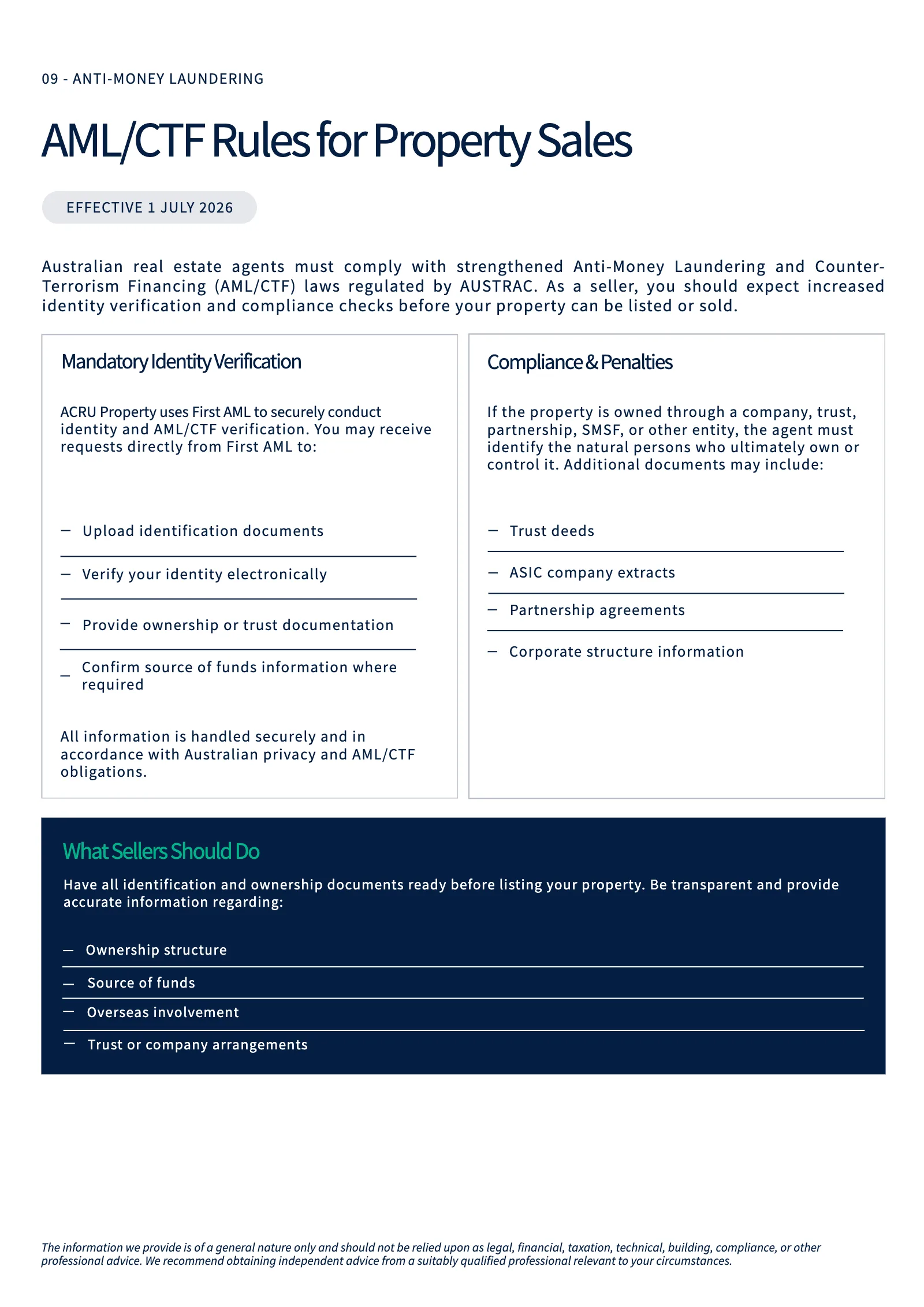
09 - ANTI-MONEY LAUNDERING AML/CTF Rules for Property Sales Australian real estate agents must comply with strengthened Anti-Money Laundering and Counter- Terrorism Financing (AML/CTF) laws regulated by AUSTRAC. As a seller, you should expect increased identity verification and compliance checks before your property can be listed or sold. EFFECTIVE 1 JULY 2026 Mandatory Identity Verification Compliance & Penalties Upload identification documents Verify your identity electronically Provide ownership or trust documentation Confirm source of funds information where required If the property is owned through a company, trust, partnership, SMSF, or other entity, the agent must identify the natural persons who ultimately own or control it. Additional documents may include: identity and AML/CTF verification. You may receive requests directly from First AML to: All information is handled securely and in accordance with Australian privacy and AML/CTF obligations. Trust deeds ASIC company extracts Partnership agreements Corporate structure information What Sellers Should Do Source of funds Ownership structure Overseas involvement Have all identification and ownership documents ready before listing your property. Be transparent and provide accurate information regarding: Trust or company arrangements The information we provide is of a general nature only and should not be relied upon as legal, financial, taxation, technical, building, compliance, or other professional advice. We recommend obtaining independent advice from a suitably qualified professional relevant to your circumstances. ACRU Property uses First AML to securely conduct
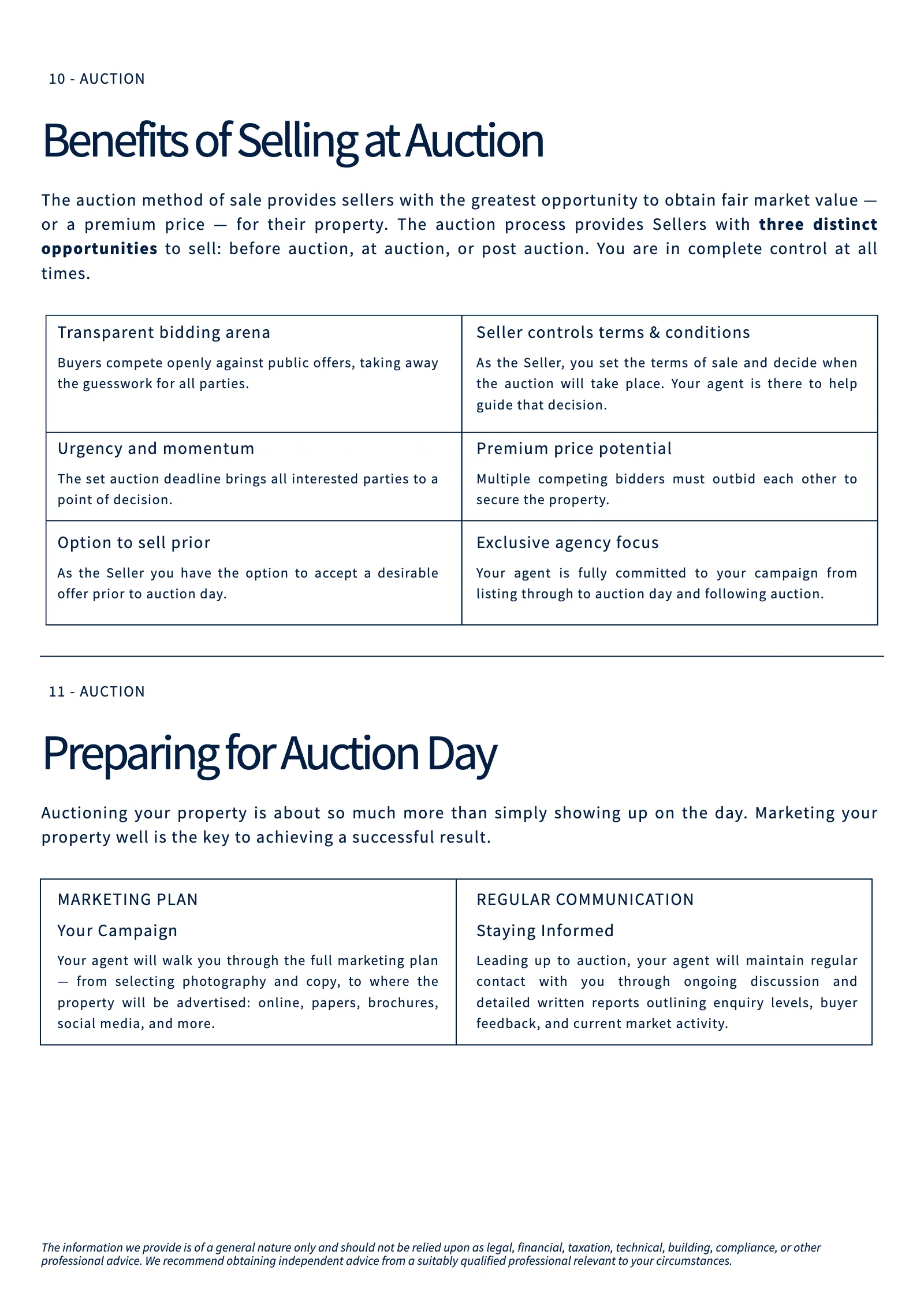
10 - AUCTION Benefits of Selling at Auction The auction method of sale provides sellers with the greatest opportunity to obtain fair market value — or a premium price — for their property. The auction process provides Sellers with three distinct opportunities to sell: before auction, at auction, or post auction. You are in complete control at all times. 11 - AUCTION Preparing for Auction Day Auctioning your property is about so much more than simply showing up on the day. Marketing your property well is the key to achieving a successful result. Transparent bidding arena Buyers compete openly against public offers, taking away the guesswork for all parties. Seller controls terms & conditions As the Seller, you set the terms of sale and decide when the auction will take place. Your agent is there to help guide that decision. Urgency and momentum The set auction deadline brings all interested parties to a point of decision. Premium price potential Multiple competing bidders must outbid each other to secure the property. Option to sell prior As the Seller you have the option to accept a desirable offer prior to auction day. Exclusive agency focus Your agent is fully committed to your campaign from listing through to auction day and following auction. Your Campaign Your agent will walk you through the full marketing plan — from selecting photography and copy, to where the property will be advertised: online, papers, brochures, social media, and more. Staying Informed Leading up to auction, your agent will maintain regular contact with you through ongoing discussion and detailed written reports outlining enquiry levels, buyer feedback, and current market activity. MARKETING PLAN REGULAR COMMUNICATION The information we provide is of a general nature only and should not be relied upon as legal, financial, taxation, technical, building, compliance, or other professional advice. We recommend obtaining independent advice from a suitably qualified professional relevant to your circumstances.
12 - AUCTION Open Homes Before Auction Day Open homes are one of the most effective ways to market a property. They are essential so that potential bidders can experience the home before committing to attend the auction and bid. 13 - AUCTION The Reserve Price Your Local Agent and Auctioneer will explain the reserve price in detail and develop a strategy for the auction based around it. Your Auctioneer will always be working to ensure you get the best price possible. Controlled viewing times limit disruption while maximising qualified buyer foot traffic Open homes can create plenty of activity, even in a slow market Interest and activity can trigger urgency with buyers Your agent can gauge how many buyers plan to register and bid Buyer feedback on price, presentation and appeal informs the auction strategy "The Auctioneer will use information received throughout the marketing campaign to suggest a strategy for auction day." Keep it confidential You remain in control Auction provides the best opportunity Never openly discuss your reserve price with others. The auction should focus on the property — price should become a secondary factor for buyers. If the highest bid meets your expectations, you can take it and finalise the sale. If not, the property will be passed in, opening the door to negotiate with all interested parties. Auction gives you the best chance to sell without undesirable terms and conditions attached. "It's important to be clear on what your reserve price is, and how it will be used during the auction." The information we provide is of a general nature only and should not be relied upon as legal, financial, taxation, technical, building, compliance, or other professional advice. We recommend obtaining independent advice from a suitably qualified professional relevant to your circumstances.
14 - AUCTION Your Role on Auction Day It is recommended that you attend your Auction. Buyers commonly request to vary the deposit amount or alter the settlement date during the bidding — your immediate input may be required to allow bidding to continue. 15 - AUCTION Frequently Asked Questions The role of your Local Agent and Auctioneer is to bring you the highest price the market will pay. Preparation is key — review all market information provided before auction day so you are ready to make a confident, educated decision. Are you Auction ready? Q1 What if no one registers to bid? Q2 What if there are registered bidders, but nobody bids? Q3 What if the reserve price is not reached? Q4 What happens if the property sells at Auction? The Auctioneer will formally pass the property in and inform any attendees of the next steps to take. In reality, this is an uncommon outcome. The Auctioneer may nominate a vendor bid — a starting bid that cannot exceed the Seller's reserve price — to create momentum and get the auction moving. Your Auctioneer can pause the auction and attempt to negotiate with the highest bidder. If neither party will move, the property will be passed in. straight away. You will sign the contract, the Buyer will arrange the deposit, and the sale will transact on the agreed terms. The information we provide is of a general nature only and should not be relied upon as legal, financial, taxation, technical, building, compliance, or other professional advice. We recommend obtaining independent advice from a suitably qualified professional relevant to your circumstances. Once the Auctioneer announces "sold", the ACRU Property team will process the contract of sale
The information we provide is of a general nature only and should not be relied upon as legal, financial, taxation, technical, building, compliance, or other professional advice. We recommend obtaining independent advice from a suitably qualified professional relevant to your circumstances.